Thursday, October 11, 2012

Assessing Expropriation Risk: The Dynamics of Expropriation

Direct frontier markets investment is associated with a host of risks, of which expropriation is the most prominent. [4]

In this post, I will outline an approach that could be used to estimate expropriation risk. Further, I will also discuss the dynamics of expropriation using: the J-Curve; a conceptual tool that was developed by Ian Bremmer, and; the assertions that I drew from Bruce Bueno De Mesquita and Alastair Smith's text entitled "The Dictator's Handbook".

 ***

The questions that would be used to shape this blog post can be abbreviated as follows:
  • When does expropriation occur?
  • What are the drivers of expropriation?


When does expropriation occur?

The following quote, from David Landes's text entitled "The Wealth and Poverty of Nations", has got clues on the political conditions that amplify the risk of expropriation:

"In despotisms, it is dangerous to be rich without power. It arouses cupidity
and invites seizure."
- David Landes (The Wealth and Poverty of Nations)

From the assertion that was made by David Landes, one can infer that the risk of expropriation increases in conditions of despotism, i.e. where political power is repressive and concentrated. The concentration of political power in a society can be estimated by employing the following "selectorate index": The number of people who are eligible to vote under the laws of a nation divided by The number of people who would be eligible to vote if the nation adopted international standards of democracy and universal suffrage. [1]
To this inference, I would also add the following supposition: the risk of expropriation increases in conditions of high inequality, i.e. where wealth is concentrated. Why? Because in conditions of great inequality, the masses tend to support radical redistributive policies; which naturally "emboldens office bearers". The level of income inequality in a society can be estimated by using the Gini coefficient.

Hence, the abovementioned inference and supposition can be used to plot the following graph:


Illustration 1: Click on illustration to zoom in


In Illustration 1, the movements upwards and to the left, depicted by red arrows, indicate an increase in expropriation risk. The greatest increase in the general expropriation risk is depicted by the movement from Quadrant 2 to Quadrant 1. The move from Quadrant 3 to Quadrant 1 indicates an increase in the probability of a mass revolt and an increase in the expropriation risk of politically well-connected entities. And, the movement from Quadrant 4 to Quadrant 3 represents a moderate increase in the short term risk of expropriation; however,the move is usually ensued by the movement from Quadrant 3 to Quadrant 1 - so it represents a high increase in the risk of expropriation within a 3 to 5 year period. [8]

The conceptual framework in Illustration 1 can be supplemented by the adaption of Ian Bremmer's J-Curve in Illustration 2:

Illustration 2: Click on illustration to zoom in


I'll start by explaining the general concept of the J-Curve, by using an excerpt from "The J-Curve" book press release: "If you take a cross section of nations and measure each one’s stability in relation to its political and economic openness to the outside world, and then plot the resulting data points on a graph, the result is a curve shaped like a J. Nations to the left of the dip in the J are less open; nations to the right are more open. Nations higher on the graph are more stable; those that are lower are less stable. Movement from left to right along the J curve demonstrates that a country that is stable because it is closed must go through a period of instability as it opens to the outside world."

To give the conceptual framework in Illustration 2 practical utility, the following proxies can be employed:
  • Percentage Change in Exports for Openness.
  • Percentage Reduction in Incidents of Social Unrest for Stability.
In Illustration 2, the yellow circle that overlays the J-Curve is labelled "The Zone of the Greatest Danger of Expropriation". This italicizes the following mutually exclusive features of expropriations:
  1. Expropriations occur when a country is starting to become more open: When a country is starting to become more open stability falls, as it moves up the J-Curve. In Illustration 2, this is illustrated by the move towards point a from the left hand side of the J-Curve. Usually, when this shift occurs, the entities that were closely associated with a deposed autocratic regime stand the risk of expropriation.
  2. Expropriations occur when a country is increasingly becoming more closed: When a country is becoming more closed, stability falls as it moves down the J-Curve. In illustration 2, this is illustrated by the move towards point a from the right hand side of the J-Curve. Usually, when this happens, the following entities face the risk of expropriation: Foreign entities, Entities that were closely associated with a deposed political faction/party and Entities from sectors of the economy that are of the most importance and generate the most revenue (in forex terms).


What are the drivers of expropriation?

In their text entitled "The Dictator's Hand Book", Bruce Bueno De Mesquita and Alastair Smith state that there are generally three constituencies of political importance in a society [2]: The Nominal Selectorate, The Real Selectorate and The Winning Coalition. Illustration 3 below describes the constituencies, and, it positions them in terms of their political importance to an incumbent political leader:
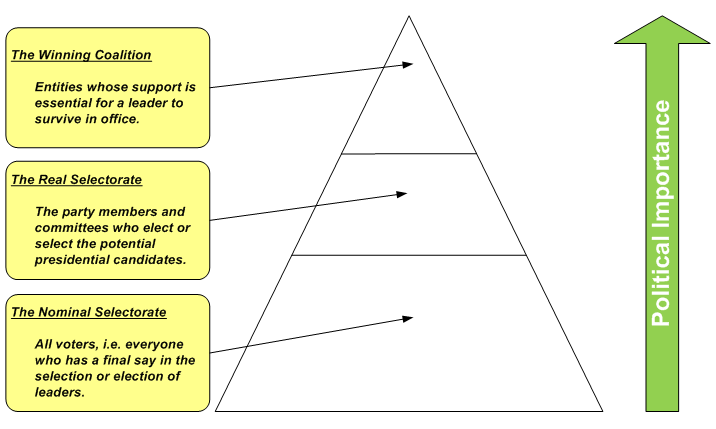

Illustration 3: Click on illustration to zoom in


According to De Mesquita and Alastair, an incumbent politician's chief concern is to stay in power. To stay in power, a politician requires the support of The Real Selectorate and a subset of The Real Selectorate that they term The Winning Coalition (see Illustration 3). This support is, according to the authors, essentially "bought with money".

Therefore, it is reasonable to assert that the risk of expropriation of an entity increases when:
  • The support base of an incumbent is dwindling: When this happens, the price of the support of The Real Selectorate increases, i.e. it would take more money to get them to rally behind an incumbent. If additional funds can only be accessed with more effort than the effort that is required to expropriate assets, the incumbent will do the logical thing: expropriate assets.
  • When The Real Selectorate grows: When this occurs, more money is needed to buy the support of an increased number of key people. Again, if additional funds can only be accessed with more effort than the effort that is required to expropriate assets, the incumbent will do the logical thing: expropriate assets.
  • When a country is undergoing financial hardship: Traditional sources of funds dry-up and new sources of funds need to be secured to buy the continued support of The Winning Coalition. The said "new sources of funding" may be the expropriated assets that are owned by "dispensable entities".
  • When political rivals can make better offers to The Real Selectorate: An incumbent would be forced to make a higher bid. And, this naturally requires more money. Again, if additional funds can only be accessed with more effort than the effort that is required to expropriate assets, the incumbent will do the logical thing: expropriate assets.
  • The entity is a marginal member of The Real Selectorate: According to De Mesquita and Smith, incumbents prefer a Winning Coalition that is as small as possible. They periodically cull-out members of The Winning Coalition who: 1) Have the power to depose them; 2) Have got questionable loyalties; 3) Have got great abilities and ambitions, and; 4) Are dispensable. [5].
I know that this sounds a bit radical, so I will close off with a story that will illustrate some of the above-mentioned drivers in action:


Dokolo - wealthy beyond the dreams of avarice

In the late 1960s, there lived, in Zaire (now called the DRC) a man called Augustin Dokolo Sanu. He was wealthy beyond the dreams of avarice and he had interests in Banking (The Bank of Kinshasa), Agriculture, Food Processing, Car Dealing, Mining, Transport, Printing, Insurance Brokerage, Customs Clearance, Real Estate and Trading.

By all accounts, Dokolo's empire aroused both admiration and envy. Just about every prominent member of the Zairean society wanted to be associated with him. Between the 1960s and the 1980s, Dokolo was offered numerous public sector positions. Being the time pressed man he was, he always declined by saying that he didn't have enough time to focus on anything that was not related to his business interests.

Dokolo's wealth largely depended on a strong copper price. And, when the demand for copper started to soften, most of his bank's debtors, copper miners, found it difficult to service their debt. Owing to this,  support from the central bank was needed to enable The Bank of Kinshasa to fulfil its commitments to foreign creditors.

Around 1985, The Bank of Kinshasa (BK), was charged onerous "new" interest rates for borrowing from the Zairean central bank. These interest charges (including the principal) amounted to 97% of Dokolo's "revised" networth (i.e. According to the valuations of the Zairean central bank; which accused him of using his real estate company to inflate the valuations of his assets [7]). Unbeknownst to Dokolo, these new interest rate charges and revised valuations were to mark an inflection point in the trajectory of the Dokolo empire.

As fate would have it, Dokolo didn't have enough liquid assets to cover the predatory interest charges. Naturally, this put depositors' funds at risk. Thus, he was forced to surrender the majority of his personal fortune as surety and his bank went into "indefinite" administration; i.e.  he never got his bank back and he never got back the assets that were surrendered as surety [6]. The long and short of it is: his assets were nationalized by the government of Mobutu Sese Seko.

Mobutu is the man who once said something that lends credence to the assertion that was made by De Mesquita and Smith (i.e. the assertion that political leaders buy the support of key constituencies with money), and I quote:

"What is important here is cash. [A] leader needs money, gold and diamonds to run his hundred castles, feed his thousand women, buy cars for the millions of boot-lickers under his heels, reinforce the loyal military forces and still have enough change left to deposit into his numbered Swiss accounts."
I think the quotation has got clues on what Dokolo's expropriated wealth was used for...

***

[1]  It is important to point out that this formula is a crude method of estimating the concentration of power in a society and it was merely used for illustrative purposes.
[2]  Bruce Bueno De Mesquita is an academic and a consultant with the C.I.A. He developed a computerized system that is underpinned by Game Theory and Graph Theory; the system can predict future events that involve complex negotiations between numerous entities. And, according to the C.I.A, the system has got a 90% accuracy rate when it comes to predicting events that occur on the global geopolitical landscape. Because of this, people call Bruce a modern Nostradamus.
[3]  The authors' assertions are underpinned by rigorous quantitative and qualitative analyses, and, they are backed up by empirical evidence from across the globe. Please read the book, in its entirety, before you dismiss these assertions.
[4]  According to Investopedia, expropriation is "the act of taking of privately owned property by a government to be used for the benefit of the public".
[5]  The first step is usually an arrest or legal proceedings. The second step in culling-out the named entities is usually financial dismemberment via expropriation.
[6]  Dokolo never recovered from the expropriation of his assets; he spent the remainder of his life in mourning.
[7]  It is almost impossible to verify whether this charge had any substence.
[8] These are generalizations. Contextual information is needed to interpret the true implications of these shifts.

Tuesday, September 25, 2012

Banks and Entrepreneurship in Africa

I’ve been studying how the financial sectors of most Sub-Saharan African economies work; particularly how their lending practices influence patterns of entrepreneurship.

When I started the ad hoc study, I made the mistake of examining them through the frame of reference of an economist; I looked more at numbers and statistics than stories. Because of this, I got lost in the complexity of numerals and I missed the dynamics that were at play.

***

Sub-Saharan African countries have got some of the highest Gini coefficients in the world; incomes (and assets) are generally concentrated in the hands of a few, see the chart below (2011 data):

Click on illustration to Zoom in

As a risk mitigation measure, banks prefer to lend money to entities that own assets that can be collaterized; i.e. bank funding can only be accessed by a few entities (owing to the above-mentioned inequality). In this blog post, these "few entities" will be termed the "asset-rich".

At the opposite end of the spectrum, are the marginalized "asset poor". Banks don't cater to their needs for capital, and, the capital markets in most Sub-Saharan African economies lack the depth and sophistication that would allow the “asset poor” to access funding.


 ...The Questions I had when I was studying Sub-Saharan Financial Sectors

What happens to the capital that is accessed by the "asset-rich entities"? And, how do entrepreneurs without assets access capital? 
I thought that these were two distinct questions; until I studied the recent bank failures in Zimbabwe.

When the "asset-rich" get loans from the banking system, they do either of the following:
  • Use the loans to finance the expansion of their ventures. There are, of course, natural limits to this (The Law of Diminishing Returns). [1]
  • Hunt for start-up entrepreneurs who require funding. They can either "bolt them onto their corporate infrastructure" or acquire preferred equity stakes in the ventures (or convertible debt). To do this effectively, the asset-rich require competences in talent spotting and the identification of emergent trends.[1]


...The Hierarchy of Asset "Irreplaceability" 

Generally, the assets of a venture have the following hierarchy of "irreplaceability":

Click on illustration to Zoom in

By and large, Money and Physical Assets tend to be easier to replace than Human Capital and Social Capital: From a value-generating standpoint, Human Capital and Social Capital tend to be superior to Money and Physical assets.

Nascent ventures tend to possess more Human Capital than; Social Capital, Money and Physical Assets. In most cases, Money and Physical assets are the scarcest "assets" in start-up ventures. Without Money and Physical Assets, the value-generating potential of Human Capital and Social Capital remains dormant.

Therefore, to unleash the value-generating potential of their Human Capital and Social Capital stocks, start-up entrepreneurs tend to partner "asset-rich" entities (in a bid to access funding).


...It's a Buyers' Market

There are generally more start-up entrepreneurs with great ideas than there are asset-rich entities with access to funding (i.e. the opportunity cost of capital is high) [2]. If one takes the start-up entrepreneurs as sellers of investment opportunities and asset-rich entities as buyers of investment opportunities, the market for start-up funding can best be described as a buyers' market. Otherwise stated, the Human Capital and Social Capital of start-up ventures in most Sub-Saharan African markets tends to be undervalued in most capitalization agreements that they enter into (with "asset-rich" entities). Hence, in equity capitalization transactions, start-up entrepreneurs end-up with much less equity in their ventures than they "deserve" (as determined by the Hierarchy of Irreplaceability Principle, i.e. the more Irreplaceable an asset is, the higher its value).


...Scaling-up Operations and the Reduction of Bargaining Power

For start-up ventures to scale their operations, two things have to occur:
  1. The skills and knowledge of the entrepreneurs have to be transferred to, and supplemented by the skills of their employees. This process unleashes more human capabilities for use in expansion.
  2. The tacit knowledge of the entrepreneurs has to be codified and embedded into the ventures' business models, operations, systems and processes. This process makes it possible for ventures to apply, in a scalable fashion, efficiency-enhancing management techniques like Total Quality Management (TQM).
Owing to the above-mentioned factors, the "irreplaceability" of the ventures' Human Capital stocks diminishes (refer to the second illustration). When this happens, the relative bargaining power of the entrepreneurs, vis-à-vis the bargaining power of the asset rich entities, diminishes.


...What effect does this have?

When the start-up ventures are in the high growth phase of their respective business lifecycles, they tend to require regular incremental fixed and working capital injections to shore-up their operations.

To minimize the risk in their capital structures, most of these start-up ventures prefer to use equity funding to bolster their operations. The avenue of choice for equity financing tends to be a rights issue, which generally tends to be associated with the following chain of causation:

Click on illustration to Zoom in

As the illustration above shows, in such scenarios, start-up entrepreneurs' equity holdings tend to be progressively diluted with every rights issue that occurs. Eventually, the people who benefit most from entrepreneurs' talent tend to be the "asset rich" entities [3].

Clearly, this doesn't bode well for the incentivization of entrepreneurship.


...What can be done to remedy this?

To remedy this, Africa needs:
  1. Financial sector reform.
  2. Deep public debt markets that increase the efficacy of financial intermediation.
  3. A high-yield bond revolution that is akin to Mike Milken's "Junk Bond Revolution".

[1]  The Zimbabwean bank failures that recently occured materialized because Zimbabwean asset-rich entities did not quite get the Law of Diminishing returns and they did not have competencies in talent spotting and the identification of emergent trends. Owing to this, they lost money in their ventures and they were unable to repay the banks. 
[2]  The asset-rich have got a preference for different types of opportunities, they include; 1) Opportunities that generate a positive ROI quickly - these tend to be prefered by entities with a short term outlook and high risk aversion, 2) Opportunities that will remain profitable even if Zimbabwe returns to great turbulence - these tend to be preferred by entities that seek "all-weather returns" and 3) Investment oppetunities that will profit if Zimbabwe becomes stable - these tend to be preferred by entities with a positive outlook.
[3]  These asset-rich entities end-up being called "serial entrepreneurs" or "magnates". And, everyone admires them for their "entrepreneurial talent" that spans across different sectors and industries.

Sunday, June 10, 2012

How the Distribution of Power Shapes Societal Events

"Power is not an institution, and not a structure; neither is it a certain strength we are endowed with; it is the name that one attributes to a complex strategical situation in a particular society."
~ Michel Foucault

If you read any publications from the "fringes" of society, you will probably encounter the word "establishment". Generally, this word is used in reference to entities that wield a large proportion of the political power in a society.

The eccentric personalities who write about "the establishment" tend to toggle freely between sane and insane frames of mind, and their florid accounts usually seem science-fiction-ish. However, their articles tend to be engaging and they make you ponder deeply about the mysteries of this world.

***

In this post, I will use a model called The Establishment Triangle, and its elements (including; Big Unions, Big Companies and Big Governments), to discuss the forces that shape the destiny of most contemporary liberal democracies. I am not sure exactly where I encountered this conceptual tool, but it has helped me to understand the distribution of power, patterns of transactions and political events that occur in most liberal democracies.

Before I discuss the establishment triangle, I would like to point out an observation that Will Durant made when he dissected 6,000 years-worth of world history in his text entitled Lessons of History:
"Most governments have been oligarchies-ruled by a minority, chosen either by birth, as in aristocracies, or by a religious organization, as in theocracies, or by wealth, as in democracies. It is unnatural (as even Rousseau saw) for a majority to rule, for a majority can seldom be organized for united and specific action, and a minority can. If the majority of abilities is contained in a minority of men, minority government is as inevitable as the concentration of wealth; the majority can do no more than periodically throw out one minority and set up another."
Hence, it is important to note that virtually every government in every society is an oligarchy, ruled by a minority that I will term The Establishment. But who are they?


The Establishment

The establishment in most contemporary societies mainly consists of three forces, (Big) Government, (Big) Unions and Big Companies; i.e. the organizational entities that different groups of individuals use to satisfy their Maslovian needs. The state of affairs in any society is usually the result of the dynamic tensions that stem from interactions of these organizational entities.


The Establishment Triangle


Big Companies
  • They are large companies in industries that are at the mature phase of their life cycles.
  • They generally seek political power and influence for use in the erection of barriers to entry that would keep new industry entrants at bay.
  • They are primarily interested in maximizing shareholder value by getting a disproportionate share of government contracts (i.e .government spending), and, by minimizing the cost of doing business (through lobbying for less regulation - which reduces transaction costs).
  • They generally desire a low cash tax rate because it maximizes their cash holdings. These companies primarily use their cash reserves to reduce business risk by buying-in new innovations and by making defensive acquisitions.
  • They are managed by men and women of great merit who are usually "hubs" in elite social networks.
  • They prefer smaller governments that they can easily control.
  • They ultimately serve the interests of the financial and stock owning elites. 
  • They are net job killers and the main enemy of Big Unions.

Big Unions
  • They exist to enhance their members' job security, and, to lobby for more earnings per unit of man hours.
  • They generally seek political power to; leverage in their negotiations with Big Companies, erect barriers of entry in labour markets (i.e. reduce immigration) and to reduce the threat of competition from foreign labour (i.e. minimize the adverse effects of outsourcing and offshoring).
  • They generally seek lower payroll taxes and consumption taxes to maximize the disposable incomes of their members.

Big Governments
  • They are usually headed by cabals of Machiavellian politicians who rise to power by using the grass roots structures of Big Unions and the funding of a minority of Big Companies (that usually operate in the following industries: Infrastructure, Defense and Pensions / Investment management).
  • They exist to pay back favours they received from Big Unions, Big Companies and segments of society that propelled them to power. In short, they appease their patronage networks via Government spending and contracts.


How the Forces Act

The prevalent state in any society is usually the admixture of the below mentioned scenarios, although one scenario usually tends to be predominant:

Scenario 1: When Big Companies are relatively powerful
  • Corporate Taxes and Capital Gains taxes are generally low - and social welfare projects are underfunded.
  • Incomes are on an downtrend in real terms and people increasingly use debt to supplement their dwindling incomes. Usually, this debt binge fuels an economic expansion that increases employment,  resulting in a prosperity illusion and real prosperity.
  • Wealth transfers from middle class to the upper class occur.
  • Risky assets perform well.
  • Income inequality increases and this may result in greater societal instability. To minimize the threat of instability, the government responds by increasing the size of the military / police and it intensively recruits members from restive pockets of society to: 1) Discipline them through military / police training, and; 2) Help contain civil unrest and crime.
  • Recessions are likely to occur at the end of the debt accumulation cycle. And, it is then that the prosperity illusion vanishes.

Scenario 2: When Big Unions are relatively powerful
  • Payroll taxes are generally low.
  • Incomes are high.
  • Wealth transfers from the Upper class to the Middle and Lower classes occur. This frustrates the elites, which causes them to divest from the economy. The government responds to this by increasing taxes on divestment and erecting exit barriers to business. This deters further inward investment.
  • Income inequality falls, i.e. in the short term.
  • The efficiency of businesses falls.
  • The economy becomes chronically uncompetitive and sectors with the most powerful unions lobby for subsidies.
  • Barriers to imports are erected to protect unionised industries from foreign competition.
  • Immigration is reduced and xenophobic and nationalistic sentiments become ubiquitous.
  • This type of government artificially bolsters wages while productivity and employment are falling. Hence, it is typically associated with stagflation / inflation.

Scenario 3: When Big Governments are relatively powerful
  • The size of the government increases and it has to be funded by either a commensurate increase in taxation or government indebtedness, or both.
  • The government budget deficit increases exponentially.
  • The tax code becomes complex and hard to interpret, because each line would serve to address the demands of a specific special interest group.
  • Transfers of wealth occur from all sectors of society to government contractors and favoured constituencies.
  • Wealth becomes concentrated in the hands of a few oligarchs.
  • Bureaucracy increases and inefficiency becomes rife.
  • This type of government is usually toppled by a sovereign debt crisis that causes a (depression or) a recession. Or, it may cause hyperinflation if it chooses to inflate away its debts.
  • The excesses of this form of government increasingly shift the support of the masses to the political surrogates of Big Companies.

Scenario 4: When Big Unions, Governments, and Companies have an equal amount of low power
  • A fourth internal/external force comes in to seize the power, and, wealth would be concentrated in the hands of that "fourth force"

***

Big Unions, Companies and Government don't usually collaborate, i.e. unless it is to squash a threat that would: curtail job security, remove barriers to entry and dismantle patronage networks. The most common points of origin for such threats are; technological and financial innovation.

Saturday, October 15, 2011

The Twitter Hedge Fund Series: Using Twitter As a Sentiment Indicator - Part 1

I was reading a paper entitled Constructing consumer sentiment Index for U.S. Using Internet Search Patterns by Messrs  Nicolas  Della Penna and Haifang Huang, when it occurred to me that their methodology could be applied to Twitter.


In their paper, Messrs Penna and Huang assert the following:
  • The search term "Bankruptcy" is an indicator of adversarial financial conditions. The higher its frequency; the more adversarial the financial conditions.
  • The search phrase "Office Furniture" is an indicator of improving business conditions. The higher its frequency; the higher the vibrancy of business conditions.
  • The search phrase "Luxury Goods" is an indicator of increasing willingness to spend on discretionary items. Generally, the higher its frequency; the more bullish the economic outlook.
  • The search phrases "Oil and Gas", "Electricity", "Alternative Energy" and "Hybrid vehicles" indicate attention to energy cost - which shows a bearish outlook. The higher their frequency; the more bearish the economic outlook.
As a rough test of the applicability of their methodology to Twitter, I picked the terms "Bankruptcy", "Luxury"and I extracted the frequency with which they appeared in tweets from the 24th of April to the 9th of October. Here is what I got:

Chart 1: The encircled points indicate the things that immediately stood out
Click on image for better visibility


Find below my commentary on each of the points:
  • The first encircled point between 1-8 May: Here the term 'Luxury' is twitted with the greatest frequency. And the differential between the frequency with which the term is twitted  and the frequency with which the other terms are twitted is at its greatest. This indicates that the outlook around the 5th of May was at its most bullish. Since the S&P 500 is an indicator of general market sentiment, this should reflect in the index anytime between the 1st and the 8th.  However, in chart 2, the S&P 500 actually is on a downtrend during that period... Nonetheless, I would be interested in finding out how stocks of luxury oriented products performed then.
  • The second encircled point between 12-19 June: The frequency with which the term 'Electricity' appears in tweets hits a peak, 'Bankruptcy' also hits a peak and while 'Luxury' is on a dip. In aggregate, this indicates bearish sentiment. In Chart 2, between June 13 and June 14 the S&P 500 actually dips -  i.e. the market trend is in sync with the twitter trend! As a side note, I would be interested in finding out how energy stocks performed then.
  • The third encircled point between Jun 26-July 3: 'Bankruptcy' hits the highest peak and the other two terms also peak. In aggregate two out of the three indicators indicate bearish sentiment. So, this should be taken as a sign of bearish sentiment. In chart 2, the S&P 500 actually dips between the 26-28th of July -  i.e. the market trend is in sync with the twitter trend! As a side note, I would be interested in finding out how an index of luxury stocks performed then.
  • The  forth encircled point between August 28 and September 4: 'Bankruptcy' hits a trough and 'Electricity' and 'Luxury' are on an uptrend. Two out of the three indicators are bullish, so this should be a sign of a bullish outlook. In chart 2, on the 29th of August the S&P 500 opened at 1,177.91 and closed at 1,210.08 -  i.e. the market trend is in sync with the twitter trend! As a side note, I would be interested to find out how energy stocks performed during that time period.
Chart 2 below shows points that correspond with the discussed sentiments:


Chart 2 S&P 500 movements that correspond to the sentiment terms
Click on Image for better visibility

Although I used a very crude method, the sentiment indicators do appear to have some reflective power. So, I will dig deeper to see if they may have any predictive power.


I'll first start by creating a content aggregator that draws each of the above mentioned terms from Twitter. For this exercise I will use Yahoo Pipes and my aggregator  looks like this:


Chart 3: Content Aggregator
Click on Image for Better Visibility


The data feed that I will mine and draw trends from can be accessed from here  (Click on the 'List tab'for the aggregated raw tweets)

In a subsequent post I will create a Twitter sentiment indicator, from the data I draw from the aggregator, and see if it has any predictive power.


Stay tuned, that is the interesting part!

Tuesday, September 6, 2011

Going Back to the Gold Standard

Over a year ago, I wrote a blog post on the specie gold standard 'method' of money supply management. At that time, I was certain that this would be the last blog entry I would make on this subject (I don't like blogging about gold). However, recent occurrences in the Eurozone (and the US) have forced me to reflect again on this topic:

In this post, I will conduct a thought experiment on the implications of returning to the specie gold standard of money supply management.

Let us postulate that the world returns to the specie gold standard of money supply management, and that the system possesses the following features:
  • All forms of money in circulation in each country, i.e.; M0, MB, M1, M2, M3, MZM, represent actual gold in the vaults of each respective country's Central Bank.
  • Whenever Nation X imports goods/services from Nation Y, gold that is comensurate with the value of the traded goods/services, is shipped from the vaults of Nation X's central bank to the vaults of Nation Y's central bank. Thus, this implies that imports deplete a country's gold reserves and its money supply, and; that exports grow a country's gold reserves and its money supply.
What would happen in such a system?

1) The Fractional Reserve System would create less money

Currently, banks around the world (except those in Islamic countries) employ the fractional reserve system to create money.

What is it? This is best illustrated by way of an example. Let's say that a bank receives $1,000 in clients' deposits. In this country for every $1 transaction that occurs in cash, 7.33 times the number of cheques are accepted. The bankers are unsure about the frequency of withdrawals, so they decide to leave the depositors' money untouched.

People trust the banking system and each other, and cheques are as good as cash. Hence, instead of lending the depositors' funds to borrowers, the bank can simply issue cheque books, that correspond to the amounts that each borrower seeks. And, the borrowers could write cheques up to their respective requested loan amounts.

Being rational people, with MBAs from IMD, INSEAD and Harvard Business school, the bankers decide to gain operational leverage from the community's trust by lending 7.33 times their cash base; i.e. the bank lends $7,333.33. Thus, each dollar of depositors' funds creates $7.33 dollars worth of loans in this scenario!

Contrastingly, If the specie gold standard, with the above mentioned features, was introduced, $1 worth of depositors' funds would create $1 worth of loans. Succinctly, credit, the lifeblood of the modern economy, would immediately dry-up, and this would trigger either a recession or a depression in most jurisdictions.

Simply put, the gold standard would reduce: economic growth, living standards, job creation and societal stability. Further, the gold standard would reduce the likelihood and severity of credit-induced crises, like the subprime mortgage crisis of 2007-2009. So, its disadvantages do come with an important advantage.

2) Barter Transactions would rise exponentially

To satiate human beings' unlimited needs and wants, commerce has to occur. And, money is the lubricating force of the world's engines of commerce.

The main problem with using gold as a unit of account, through the employment of the specie gold standard, is its scarcity. There is not enough gold in the world to support the volume of transactions that occur in the modern economy every day. Stated otherwise, if the specie gold standard was reintroduced, the scarcity of gold would be a checking mechanism that would curtail people's ability to satisfy their needs and wants through commerce.

It is reasonable to assert that people would circumvent the above mentioned problems by batering the goods they produce for the goods they need.

In short, the gold standard would morph the world economy into the Burning Man festival! I'm not to sure whether this is a bad thing or a good thing.

3) The rise of beggar thy neighbour protectionism

As was mentioned eslewhere, imports would drain countries' gold reserves. And, this would, in turn, cut money supply and curtail economic growth. Clearly, this is undesirable for most governments, and thus, they would institute tarrif and non tarrif barriers to imports, while vigorously promoting exports, in a bid to maximize gold reserves.

Simply put, this would trigger beggar-thy-neighbour protectionism. And, this could start a depression as acute as The Great Depression.

Still want to return to 'The Gold Standard'?

Wednesday, December 22, 2010

Trading Profits Are Spawned by Similar Forces (An example)

In his essay entitled ‘Why Capital Structure Matters’, Michael Milken asserts that, “History isn't a sine wave of endlessly repeated patterns; It's more like a helix that brings similar events around in a different orbit”. This assertion replayed in my mind when I was reading a book by David Einhorn of Greenlight Capital, entitled ‘Fooling Some People of The All of The Time: A Long Short Story’. In the book, David expositions the factors that predisposed Allied Capital (NYSE: ALD), a RIC that was trading on the New York Stock Exchange, to financial weakness.

When Greenlight started shorting Allied Capital, the RIC had a market cap of USD 2.6 billion, and it was trading at two times net asset value.

As a RIC, Allied Capital had the following features:

  • 1. It paid no taxes.
  • 2. It passed all its earnings as dividends to its shareholders.
  • 3. It was limited by law to 1x leverage.

Because of feature #2, Allied Capital could not use retained earnings to fuel its growth; it was forced to finance its growth by issuing new equity at higher multiples to book value. When it did that, ALD could then use the capital, leveraged at 1x, to make mezzanine loans to unlisted companies (A high risk investment strategy).

…Pitfalls of the Strategy

In a serious economic downturn, Allied Capital would experience severe delinquencies in its investment portfolio. And, the value of the collateral it put up for loans from its creditors would fall; which would trigger margin calls. Because the entity wouldn’t have retained earnings to serve as a loan-loss buffer (refer to feature #2); Allied Capital would only have two feasible courses of action:

  • Sell its portfolio holdings to meet margin calls: Allied Capital made mezzanine loans to unlisted companies by acquiring stakes in tranches of the companies’ collateralized debt securities. These securities are generally illiquid, and thus, hard to sell in depressed markets without incurring severe losses. Therefore, If ALD sold some of these securities at fire sale prices; it would be forced to write down the value of similar portfolio holdings. This would have an adverse impact on the firm’s NAV and the value of its collateral, which would trigger a second wave of margin calls.
  • Raise more equity to create a temporary loan-loss buffer: In economic downturns, investors usually flee from the risky stock markets to the safe havens of sovereign bonds. In short, the demand for stocks falls in economic downturns, and this puts downward pressure on the prices of listed equities. New listings generally miss pricing and capitalization targets in downturns. Therefore if ALD tried to raise equity capital during a downturn, it would do so at a very low premium to NAV. Thus, in a cyclical downturn the RIC would generally be unable to raise enough equity to insulate itself from the effects of margin calls, asset write-downs and rising delinquencies.

Hence, it is evident that the structure of Allied Capital predisposed it to collapsing in cyclical downturns.

***

The forces that contributed to Allied Capital's downfall resemble the forces that toppled players who were dealing in asset backed credit securities in 2007 and 2008. And, they have eerie similarities to the forces that led downfall of the REITs that burgeoned in the US during the 1970s (You can read about the REIT boom-bust process in ‘The Alchemy of Finance’ by George Soros, Chapter 2).

Simply stated: it appears that great investment opportunities are spawned by similar forces in financial markets. Or as Michael Milken asserted; the history of financial markets is like a helix that brings similar events around in a different orbit. So, it is profitable for one to familiarise oneself with the forces that created alpha for previous generations of investors: they are certain to come into play in the future!

Thursday, December 9, 2010

Adding a Social Layer to the Google Experience

Not too long ago, I watched an interview in which Google’s current CEO, Eric Schmidt, stated that Google would be adding a “social layer” to the Google repertoire of services. When he said that, I thought to myself: “I hope that they don’t try to resurrect GoogleBuzz or Orkut”.

As you may know, the aforementioned services were Google’s lacklustre forays into the social networking arena. And, it is very likely that the said ‘social layer’ would be a conflation of those epitomes of evil. Such a Frankenstein monster would detract from the utility of Google’s services; it would be antithetical to Google’s stated bohemian mission (to not do any evil deed).

***

…Social Features that Google should consider

In my opinion, the ‘social layer’ that Eric mentioned should assume the following form:

1. A vertical search option: Recently, I was looking for a method for valuing the (cashflow-generating) software of a tech start-up, so I keyed my search into Google’s search engine and got few relevant results. I tried to modify my search query, but that was a Sisyphean effort. And after a few more tries, I wished if Google’s search engine would just ask me to phrase the query as a question; which it would automatically pose to my Linkedin contacts (via the Linkedin Answers facility), or to my Twitter or Facebook connections (via a status update with the question). This vertical search option would complement Google’s horizontal search capabilities, and this would increase the utility of Google’s search engine.

2. An autopilot-StumbleUpon-type facility: There are times when I just want to browse the web aimlessly, looking for nothing in particular. And I wish if Google’s products could help me to do so. I use the Gmail service and Google’s search and blogging products religiously, and it is within Google’s capabilities to create an astute algorithm that uses my browsing and search history (and my recent emails and blog posts) to ‘StumbleUpon’ web content that I would find interesting. They could add a button or command (like pressing ‘Ctrl+1’) in the Chrome browser that enables me to activate the proposed feature at will. Succinctly: I would like the Chrome browser to have clairvoyant-like capabilities that enable me to find entertaining web content that I wouldn’t otherwise access. Google should also make it easy to share the content on Twitter or Linkedin through the use of simple commands (like ‘Ctrl+T’ for Twitter and ‘Ctrl+L’ for Linkedin).

Evidently, my version of the ‘social layer’ is less sexy than anything that Google can conjure-up. But as Facebook has demonstrated time and time again: simplicity enhances the user experience. Instead of trying to thwart Facebook and its social networking cohorts, Google should be working with them to bring a social feel to the Google gamut of services!