Showing posts with label Risk Estimation. Show all posts

Sunday, January 27, 2013

Reframing the De-Risking Africa debate

 "When thoughtful people disagree, you get the opportunity to learn a lot"
Ray Dalio

I've had the opportunity to re-watch the video that captures the key proceedings of the "De-Risking Africa" event that was hosted by CNBC Africa (at the just ended World Economic Forum). Surprisingly, my thoughts, when I watched the recorded footage of the debate, were different to the thoughts that raced through my mind as I watched the live screening of the debate.

When I watched the debate live, I felt that:

  1. It was too short to cover the crucial issues. I felt that it would be prudent for CNBC Africa to host follow-up events to discuss all the facets of this very pertinent topic.
  2. It moved, expeditiously, to issues of skewed risk-perception before the fundamentals were exhausted. And, I also felt that everything else was overshadowed once the discussion touched upon the emotive issue of risk-perception.

However, when I watched the video this time around, I felt that all key facets of this topic were reasonably covered. And... that with more time, they would have been exhausted completely.

In both instances, I was of the opinion that the moderator did a great job; the panellists were engaging, and; the discussion was spirited, optimistic (to a fault) and insightful; it definitely elevated my thinking. The event also motivated me to reflect on the topic of "De-risking Africa".

In this post, I will share the end-products of this reflective endeavour.


***


When I reflected on the topic of "De-risking Africa", I aimed to drill deeper than the surface issues; I desired to further explore the hidden dimensions of the issues that the panellists broached. The breadth of the topic made it difficult to tackle it head-on, so I broke it down into manageable chunks as Illustration 1 shows:


Illustration 1 (click on illustration to zoom in)


Illustration 1 shows that I employed the following three questions to scope the coverage of the topic: What is Risk? Which Risks are Prevalent in Africa? Which of these Risks can be managed?

The questions will each be briefly discussed below:


...What is Risk?

Illustration 2, below, is a quantitative definition of risk:


Illustration 2 (click on illustration to zoom in)


As Illustration 2, shows there are two components to risk; the probability of a negative event occurring and the expected loss from the event. Therefore, the term "de-risking" implies reducing or removing risk by doing either of the following:

  1. Reducing or eliminating the probability of the occurrence of a negative event, or;
  2. Reducing or eliminating the expected loss from a negative event, or;
  3. Doing both 1) and 2)

If you take a risk like "losses that stem from social unrest", governments and state agents have control over the probability of the negative event occurring; they can mitigate it by instituting policies that create employment. Whereas, private sector players can mitigate the expected losses from such an event by diversifying their investments across disparate countries and by using financial instruments to hedge their exposures. 

This serves to show that, in any discussion of "de-risking", it is of paramount importance to clearly establish which stakeholder contingent can reduce which element of risk (refer back to Illustration 2 for the elements of risk).


***


...Which Risks are Prevalent in Africa?

To answer this question, I scanned through the archives of the World Economic Forum's publications. And, I found an article which is titled Africa Faces Numerous Risks. Illustration 3 expositions the risks that, according to the article, are prevalent in Africa:


Illustration 3 (click on illustration to zoom in)


According to Illustration 3, the risks that are prevalent in Africa are: Geopolitical Instability, Climate Change. Food and Water Security Issues, and Economic Shocks.

All of these risks are interrelated in one way or another as Illustration 4 shows:


Illustration 4 (click on illustration to zoom in)


Illustration 4 expositions seven chains of causation, including:

  • Climate change → Economic Shocks (e.g. two to three years ago, climate change-induced drought affected Kenya’s horticultural industry and curtailed the nation's ability to generate sufficient hydrological electricity).
  • Climate Change → Economic Shocks → Geopolitical Instability (this chain tends to manifest itself in agrarian economies).
  • Climate Change → Food and Water Security Issues → Economic Shocks.
  • Climate Change → Food and Water Security Issues  → Economic Shocks → Geopolitical Instability.
  • Geopolitical Instability → Economic Shocks (e.g. Kenya and Zimbabwe’s tourism industries after the countries' violent elections in 2009).
  • Geopolitical Instability → Food and Water Security Issues (e.g. Darfur and Somalia during conflict times).
  • Economic Shocks → Geopolitical Instability (e.g. Falling coffee prices were cited as a cause of the 1994 genocide in Rwanda).

From these chains of causation, the following is evident:

  1. Climate change is the root cause of most Economic Shocks and Food and Water Security Issues in Africa. As emissions negotiations demonstrate time and time again, it would be very difficult to minimize the probability of the occurrence of catastrophic climate change by reducing emissions. Hence, to mitigate the climate change risk, African stakeholders should focus their attention on the "reducing the expected loss from the events" lever in Illustration 2.
  2. That similar chains of causation (e.g. Climate change → Economic Shocks, and, Climate Change → Economic Shocks → Geopolitical Instability) spawn different end-risks. Put more clearly: Geopolitical Instability arises (from a set of similar factors) in some instances and not others. This begs the question of why. The easy answer to this question is: Coordination Public Goods (i.e. Free Speech, Free Press and Freedom of Assembly, Free and Fair Elections e.t.c.) are responsible for this difference; they mitigate the risk of geopolitical instability. However, it is important for this link to be demonstrated empirically in new studies, and, it is also important to explore the other factors that play a role in mitigating geopolitical instability.

Africa has come a long way, and for the 5-6% growth rate to be sustained, it is important for stakeholders to have more solution-focused "De-risking Africa"-type debates.

By solution focused debates I mean debates that discuss how to: 1) eliminate the probability of key negative events, and; 2) mitigate the losses that would stem from the-said events. Further, it is also important to give Climate Change the lion's share of the time in such discussions (refer back to Illustration 4), because it is the root cause of most risks in Africa.

Thursday, October 11, 2012

Assessing Expropriation Risk: The Dynamics of Expropriation

Direct frontier markets investment is associated with a host of risks, of which expropriation is the most prominent. [4]

In this post, I will outline an approach that could be used to estimate expropriation risk. Further, I will also discuss the dynamics of expropriation using: the J-Curve; a conceptual tool that was developed by Ian Bremmer, and; the assertions that I drew from Bruce Bueno De Mesquita and Alastair Smith's text entitled "The Dictator's Handbook".

 ***

The questions that would be used to shape this blog post can be abbreviated as follows:
  • When does expropriation occur?
  • What are the drivers of expropriation?


When does expropriation occur?

The following quote, from David Landes's text entitled "The Wealth and Poverty of Nations", has got clues on the political conditions that amplify the risk of expropriation:

"In despotisms, it is dangerous to be rich without power. It arouses cupidity
and invites seizure."
- David Landes (The Wealth and Poverty of Nations)

From the assertion that was made by David Landes, one can infer that the risk of expropriation increases in conditions of despotism, i.e. where political power is repressive and concentrated. The concentration of political power in a society can be estimated by employing the following "selectorate index": The number of people who are eligible to vote under the laws of a nation divided by The number of people who would be eligible to vote if the nation adopted international standards of democracy and universal suffrage. [1]
To this inference, I would also add the following supposition: the risk of expropriation increases in conditions of high inequality, i.e. where wealth is concentrated. Why? Because in conditions of great inequality, the masses tend to support radical redistributive policies; which naturally "emboldens office bearers". The level of income inequality in a society can be estimated by using the Gini coefficient.

Hence, the abovementioned inference and supposition can be used to plot the following graph:


Illustration 1: Click on illustration to zoom in


In Illustration 1, the movements upwards and to the left, depicted by red arrows, indicate an increase in expropriation risk. The greatest increase in the general expropriation risk is depicted by the movement from Quadrant 2 to Quadrant 1. The move from Quadrant 3 to Quadrant 1 indicates an increase in the probability of a mass revolt and an increase in the expropriation risk of politically well-connected entities. And, the movement from Quadrant 4 to Quadrant 3 represents a moderate increase in the short term risk of expropriation; however,the move is usually ensued by the movement from Quadrant 3 to Quadrant 1 - so it represents a high increase in the risk of expropriation within a 3 to 5 year period. [8]

The conceptual framework in Illustration 1 can be supplemented by the adaption of Ian Bremmer's J-Curve in Illustration 2:

Illustration 2: Click on illustration to zoom in


I'll start by explaining the general concept of the J-Curve, by using an excerpt from "The J-Curve" book press release: "If you take a cross section of nations and measure each one’s stability in relation to its political and economic openness to the outside world, and then plot the resulting data points on a graph, the result is a curve shaped like a J. Nations to the left of the dip in the J are less open; nations to the right are more open. Nations higher on the graph are more stable; those that are lower are less stable. Movement from left to right along the J curve demonstrates that a country that is stable because it is closed must go through a period of instability as it opens to the outside world."

To give the conceptual framework in Illustration 2 practical utility, the following proxies can be employed:
  • Percentage Change in Exports for Openness.
  • Percentage Reduction in Incidents of Social Unrest for Stability.
In Illustration 2, the yellow circle that overlays the J-Curve is labelled "The Zone of the Greatest Danger of Expropriation". This italicizes the following mutually exclusive features of expropriations:
  1. Expropriations occur when a country is starting to become more open: When a country is starting to become more open stability falls, as it moves up the J-Curve. In Illustration 2, this is illustrated by the move towards point a from the left hand side of the J-Curve. Usually, when this shift occurs, the entities that were closely associated with a deposed autocratic regime stand the risk of expropriation.
  2. Expropriations occur when a country is increasingly becoming more closed: When a country is becoming more closed, stability falls as it moves down the J-Curve. In illustration 2, this is illustrated by the move towards point a from the right hand side of the J-Curve. Usually, when this happens, the following entities face the risk of expropriation: Foreign entities, Entities that were closely associated with a deposed political faction/party and Entities from sectors of the economy that are of the most importance and generate the most revenue (in forex terms).


What are the drivers of expropriation?

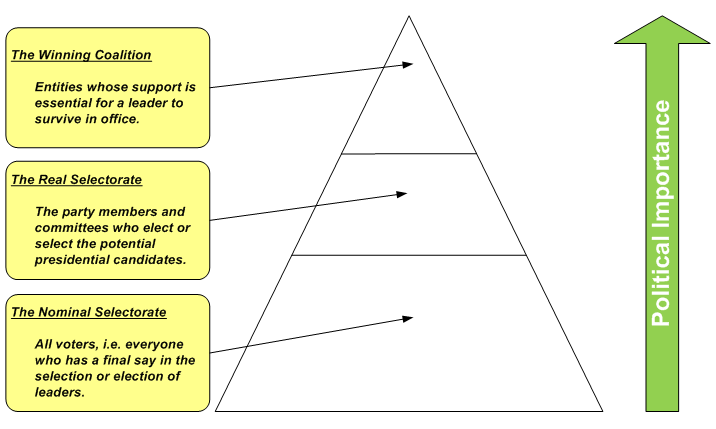
In their text entitled "The Dictator's Hand Book", Bruce Bueno De Mesquita and Alastair Smith state that there are generally three constituencies of political importance in a society [2]: The Nominal Selectorate, The Real Selectorate and The Winning Coalition. Illustration 3 below describes the constituencies, and, it positions them in terms of their political importance to an incumbent political leader:


Illustration 3: Click on illustration to zoom in


According to De Mesquita and Alastair, an incumbent politician's chief concern is to stay in power. To stay in power, a politician requires the support of The Real Selectorate and a subset of The Real Selectorate that they term The Winning Coalition (see Illustration 3). This support is, according to the authors, essentially "bought with money".

Therefore, it is reasonable to assert that the risk of expropriation of an entity increases when:
  • The support base of an incumbent is dwindling: When this happens, the price of the support of The Real Selectorate increases, i.e. it would take more money to get them to rally behind an incumbent. If additional funds can only be accessed with more effort than the effort that is required to expropriate assets, the incumbent will do the logical thing: expropriate assets.
  • When The Real Selectorate grows: When this occurs, more money is needed to buy the support of an increased number of key people. Again, if additional funds can only be accessed with more effort than the effort that is required to expropriate assets, the incumbent will do the logical thing: expropriate assets.
  • When a country is undergoing financial hardship: Traditional sources of funds dry-up and new sources of funds need to be secured to buy the continued support of The Winning Coalition. The said "new sources of funding" may be the expropriated assets that are owned by "dispensable entities".
  • When political rivals can make better offers to The Real Selectorate: An incumbent would be forced to make a higher bid. And, this naturally requires more money. Again, if additional funds can only be accessed with more effort than the effort that is required to expropriate assets, the incumbent will do the logical thing: expropriate assets.
  • The entity is a marginal member of The Real Selectorate: According to De Mesquita and Smith, incumbents prefer a Winning Coalition that is as small as possible. They periodically cull-out members of The Winning Coalition who: 1) Have the power to depose them; 2) Have got questionable loyalties; 3) Have got great abilities and ambitions, and; 4) Are dispensable. [5].
I know that this sounds a bit radical, so I will close off with a story that will illustrate some of the above-mentioned drivers in action:


Dokolo - wealthy beyond the dreams of avarice

In the late 1960s, there lived, in Zaire (now called the DRC) a man called Augustin Dokolo Sanu. He was wealthy beyond the dreams of avarice and he had interests in Banking (The Bank of Kinshasa), Agriculture, Food Processing, Car Dealing, Mining, Transport, Printing, Insurance Brokerage, Customs Clearance, Real Estate and Trading.

By all accounts, Dokolo's empire aroused both admiration and envy. Just about every prominent member of the Zairean society wanted to be associated with him. Between the 1960s and the 1980s, Dokolo was offered numerous public sector positions. Being the time pressed man he was, he always declined by saying that he didn't have enough time to focus on anything that was not related to his business interests.

Dokolo's wealth largely depended on a strong copper price. And, when the demand for copper started to soften, most of his bank's debtors, copper miners, found it difficult to service their debt. Owing to this,  support from the central bank was needed to enable The Bank of Kinshasa to fulfil its commitments to foreign creditors.

Around 1985, The Bank of Kinshasa (BK), was charged onerous "new" interest rates for borrowing from the Zairean central bank. These interest charges (including the principal) amounted to 97% of Dokolo's "revised" networth (i.e. According to the valuations of the Zairean central bank; which accused him of using his real estate company to inflate the valuations of his assets [7]). Unbeknownst to Dokolo, these new interest rate charges and revised valuations were to mark an inflection point in the trajectory of the Dokolo empire.

As fate would have it, Dokolo didn't have enough liquid assets to cover the predatory interest charges. Naturally, this put depositors' funds at risk. Thus, he was forced to surrender the majority of his personal fortune as surety and his bank went into "indefinite" administration; i.e.  he never got his bank back and he never got back the assets that were surrendered as surety [6]. The long and short of it is: his assets were nationalized by the government of Mobutu Sese Seko.

Mobutu is the man who once said something that lends credence to the assertion that was made by De Mesquita and Smith (i.e. the assertion that political leaders buy the support of key constituencies with money), and I quote:

"What is important here is cash. [A] leader needs money, gold and diamonds to run his hundred castles, feed his thousand women, buy cars for the millions of boot-lickers under his heels, reinforce the loyal military forces and still have enough change left to deposit into his numbered Swiss accounts."
I think the quotation has got clues on what Dokolo's expropriated wealth was used for...

***

[1]  It is important to point out that this formula is a crude method of estimating the concentration of power in a society and it was merely used for illustrative purposes.
[2]  Bruce Bueno De Mesquita is an academic and a consultant with the C.I.A. He developed a computerized system that is underpinned by Game Theory and Graph Theory; the system can predict future events that involve complex negotiations between numerous entities. And, according to the C.I.A, the system has got a 90% accuracy rate when it comes to predicting events that occur on the global geopolitical landscape. Because of this, people call Bruce a modern Nostradamus.
[3]  The authors' assertions are underpinned by rigorous quantitative and qualitative analyses, and, they are backed up by empirical evidence from across the globe. Please read the book, in its entirety, before you dismiss these assertions.
[4]  According to Investopedia, expropriation is "the act of taking of privately owned property by a government to be used for the benefit of the public".
[5]  The first step is usually an arrest or legal proceedings. The second step in culling-out the named entities is usually financial dismemberment via expropriation.
[6]  Dokolo never recovered from the expropriation of his assets; he spent the remainder of his life in mourning.
[7]  It is almost impossible to verify whether this charge had any substence.
[8] These are generalizations. Contextual information is needed to interpret the true implications of these shifts.